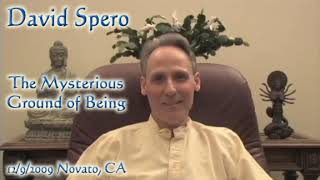
Moderator: From a participant in Sweden, “Hello David, some Advaita teachers say that the ignorant state we live in daily life is a dream state. What does this mean? And if this is so, how can we wake up from this dream?”
David: It’s not a literal dream. On the subject of Advaita Vedanta’s claim that experience and the world are dreams, I don’t believe this was meant to be a literal statement. “Dream” is used as a metaphorical term to describe the transient nature of existence. That’s all it means. The fact that things come into being and pass away does not mean that they are a dream, or exist in a dream-like state, but only that they are temporary, transient.
So, there’s no need to remove yourself from the dream, since your own self by that definition if you experience it is part of the dream. The best way to understand this idea of bondage, which is what this is all getting at, the feeling of being bound and limited, and that ultimately it is an illusion according to classical Advaita teachings, is that the sense of being at odds with oneself is itself the dream, since there is only one Self. So, to feel uncomfortable, agitated, frustrated, bound up within oneself, that recognition is the recognition that one is living in a dream, or in the illusion of separation since the symptom indicates a non-reality. The non-reality I am describing is that there can not possibly be any basis for, not the symptomology of suffering, but the actually of it as a real event. In other words, it’s like the symptoms of a cold or the flu. They’re only there while the cold and the flu are present. In the same way, the symptoms of bondage, agitation, suffering in general, restlessness, conflict, self-conflict, war within one’s self, and so on are merely the symptoms of a something that is not real. It’s fake because the primary assumption is that everything is non-separate from the beginning. So, the real dream is in the actual location of separation. It’s not in any purported area of experience. Nor is it in the world, since the world is experience. This is something of a circular argument the way Advaita presents it, but it has its own merit. If you can remember in a moment when you are suffering, that the suffering itself is the dream and not something going on inside the dream, apparent to a separate subject, then that can produce a kind of liberation.
The conventional interpretation that the world is Maya, illusion, a sense of being bewitched or hypnotized, it carries all these meanings and many more actually if you look at the root of the word Maya. It doesn’t just mean illusion. It carries a whole host of subtle meanings having to do with the way in which the mind’s absorption in itself, as Self, becomes distracted by an arising subjective happening. That subjective happening is the dream. The symptoms are the actual literal dream. The symptoms are physical, emotional and mental, but they point toward being locked in a situation that is not real. That’s the actual meaning of Maya if you look into it carefully and with deep analysis. So, if you want to practically utilize what I am describing in your experience, here’s how you can do it. At any moment when you feel completely caught up in your own suffering, you can simply identify it as a dream, but you cannot analyze further, and you must have the ability to recognize that the dream can be dispelled by the simple movement of pure attention in that moment. The simple movement of attention, in the recognition of the presumption of a dream, in the midst of experiencing suffering can liberate.
This is a sort of self-inquiry, but not directed in the classical direction that Ramana Maharshi advised toward the location of the I, but it actually accomplishes the same thing. So, you don’t have to literally ask, “Who am I,” to be released from this dream that I have been describing. Again the dream is not the world, and that dream is not the experience of the world, and the dream is not even what you call the dreamer. The dreamer is so subtle that it’s impossible to find him or her, and therefore the remedy is instantaneous remembrance that you are the Self, that you are not the dream. But, as to what we can know or cannot know about this entire affair is beyond philosophical analysis. So, this is not really a theory of suffering. Nor is it a theory to liberate from suffering. It’s just a practical suggestion offered in the spirit of Jnana Yoga teachings to self-liberate in a moment when one is lost to oneself. It’s a technique, but it’s deeper than a technique because if you practice something as a technique, you’re not really taking it seriously. The practitioner and the practice must fuse into one for it to be effective.
So, I’m suggesting that this might be a way to understand what classical Advaita means when they call the inner subject, the contents of consciousness, and even the projection of the experience of the world, illusion. None of that is meant to be literally taken, but it’s a groundwork with which to understand how freedom comes when it comes in the way that it does come through Jnana Yoga, which is the yoga of discrimination, the yoga of understanding, the yoga of waking up by the mind, through the route of mind, which is attention.
So, the way in which attention comes to itself spontaneously, by recollecting that the feeling of bondage is itself a sign that you are locked in the dream is the way out of the dream. The way out of the dream is to remember that the dream is suffering. Suffering is the location of the beginning of the process of recognition. To see that one is suffering is then to instantly be able to say, “Oh, I’m dreaming.” Now if the consciousness is mature enough of the one who says that, then there will be a subsequent understanding that follows that, a kind of relief or let go out of this contraction which is based on an illusion of separation at its root.
This is very complicated to talk about especially in the way that I am analyzing it, somewhat philosophically, somewhat casually. But I think you get the point. Somehow the truth of it is inside of what I said and not in any single sentence. And if you can let your mind relax and listen to this again, perhaps when I publish this in a clip, then you can have the opportunity to really relax and hear the message again. But until then, it’s very simple. This appreciation of Jnana Yoga and its capacity to liberate is based on a moment’s noting or notation, that first of all one’s suffering is happening inside of consciousness and nowhere else, and therefore, as soon as the sense of recognizing that one is bound to one’s suffering occurs, you can say, “That is the dream. That is the sign that I am dreaming.” And see what happens. Some people might be attracted to this suggestion, to using this suggestion, others might not be interested since their process might be more devotional.







 DL # I-58
$10.00
DL # I-58
$10.00
 DL # 137
$10.00
DL # 137
$10.00
 DL # 136
$10.00
DL # 136
$10.00
 DL # 135
$10.00
DL # 135
$10.00
 DL # I-57
$10.00
DL # I-57
$10.00
 DL # 134
$10.00
DL # 134
$10.00
 DL # 133
$10.00
DL # 133
$10.00
